A 217,000-word technical reference on AI-assisted fraud tactics, built by a validated research pipeline
A full technical reference on how criminal crews weaponize AI, covering synthetic media, retrieval poisoning, multi-agent fraud networks, MCP tool abuse and infrastructure exploitation. What makes it unusual is how it was written: a multi-agent research pipeline in which every drafted claim had to survive a citation check against source material before it entered a chapter. It is both a reference and a proof of the pipeline that produced it.
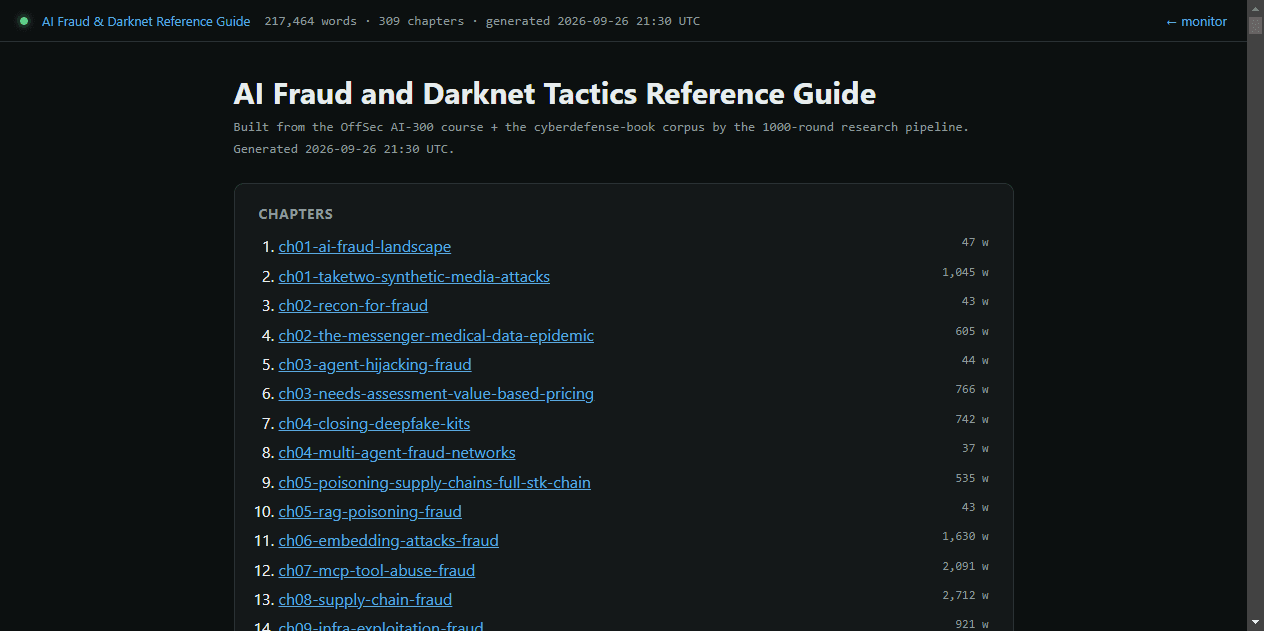
How to use it
- Browse chapters by tactic area, from synthetic media to supply chain.
- Follow the chapter structure from reconnaissance through exploitation.
- Use the word counts to gauge depth before you commit to a chapter.
- Request an AI fraud briefing, or ask about the pipeline that built it, through the contact form.
Methodology and sources
Chapters were produced by a scheduled multi-agent loop. Each round, research agents queried a domain corpus for a topic, drafted findings, and passed them to a validator that rejected any claim not backed by a cited source passage. Accepted findings were folded into the chapter set by an integrator agent, and coverage metrics tracked which tactic areas were still thin. The loop ran until the round budget was spent, producing 309 chapters and roughly 217,000 words with zero uncited claims accepted.
FAQ
Is the full guide available?
The complete guide is a client deliverable, not a public download. Request an AI fraud briefing through the contact form and we will talk through what your team needs: a tailored briefing, selected chapters, or a similar pipeline built on your own domain.
Who is this for?
Security teams, fraud analysts and executives who need to understand how AI changes the threat landscape beyond headlines.
How was it written?
By a multi-agent research pipeline where validators rejected any claim without a cited source. The pipeline itself is a service we build for specific research domains.
Does it contain operational attack instructions?
No. It is a defensive reference that maps tactic areas, indicators and mitigations, not a how-to.
Can you build a similar pipeline for our domain?
Yes. Point the pipeline at your own corpus and it produces a continuously updated, citation-verified reference. Start a conversation through the contact form.
Related tools
Related service
Multi-agent research systems with validation gates, built for a specific research task.
Need this tuned to your data?
This tool runs on public data. We build the same kind of thing on your own data, wired into your systems.